
Deal or No Deal
"Deal or No Deal" is a game show built around one remarkably simple decision: accept a guaranteed offer or continue opening cases in the hope of finishing with something better. The contestant knows which prize values remain in play, but not which one is hidden in the case they selected at the beginning.
That limited information creates the tension. There are no trivia questions to answer and few complicated rules to learn. Instead, the drama comes from watching the board change and deciding when the right moment has arrived to stop.
How the Game Works
In the best-known American version, the contestant begins with 26 numbered briefcases, each associated with a different prize value. One case is chosen to remain closed while the player gradually opens the others.
Every opened case removes its value from consideration. Revealing a small amount is encouraging because larger prizes remain possible, while eliminating one of the biggest values can dramatically change the situation.
The number of cases opened decreases as the game progresses, making each individual reveal increasingly important.

The Banker’s Offer
At intervals, play stops and the mysterious Banker makes an offer for the contestant to leave the game. The amount reflects the values still available, but accepting or rejecting it is entirely the player’s decision.
The host then asks the question that defines the format: “Deal or no deal?” Choosing Deal ends the game with the offered amount. Choosing No Deal means returning to the cases and continuing toward another offer.
This repeating choice gives the show its rhythm. A deal that seems easy to reject early in the episode may look very different after several valuable cases disappear.
The Final Cases
As fewer cases remain, the uncertainty becomes concentrated into a handful of possibilities. A contestant may be choosing between a strong guaranteed offer and the possibility that their original case contains one of the largest remaining values.
If play continues far enough, the contents of the final cases determine how the episode ends. By that point, every earlier decision can be reconsidered: whether an offer should have been accepted, whether one more round was worth continuing, or whether keeping faith with the original case paid off.
Why Such a Simple Format Works
"Deal or No Deal" requires very little explanation, which makes it easy for viewers to participate from home. The prize board is always visible, so audiences can follow the same information as the contestant and decide what offer they would accept.
Personality also matters. Some contestants prefer certainty, while others are comfortable continuing even after receiving a substantial offer. Friends and relatives often contribute advice, creating lively disagreements over what the next decision should be.
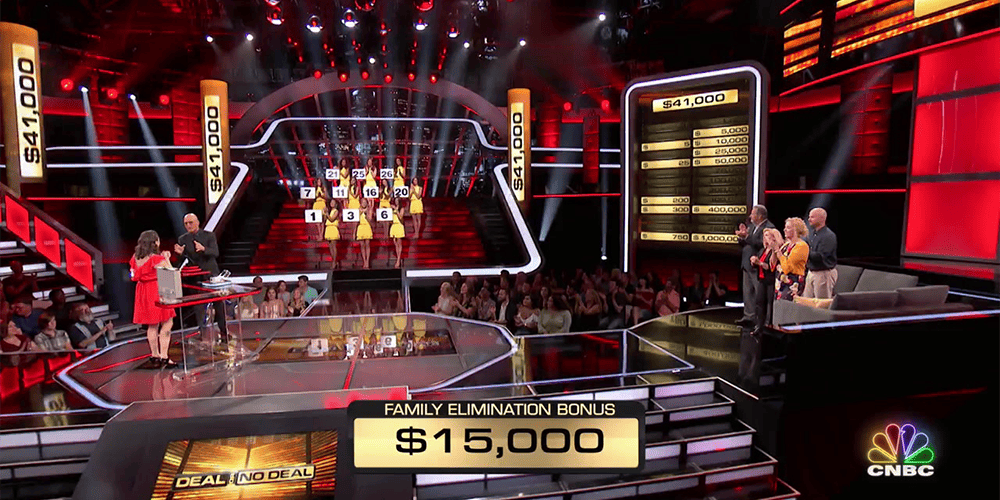
Host and Presentation
The host acts as the link between the contestant, the Banker, and the audience. Much of the role involves controlling the pace: allowing an important reveal to breathe, discussing an offer, and giving the contestant time to make a final decision.
Lighting, music, the prize board, and the deliberate opening of each case turn straightforward reveals into major moments. The presentation is designed so that viewers always understand exactly what has changed and why the next offer matters.
An International Television Format
"Deal or No Deal" has been produced in numerous countries, with local versions adapting the number of cases, prize structures, and studio presentation while preserving the same central idea.
Its longevity comes from the contrast between simple rules and difficult decisions. With almost no specialist knowledge required, each episode becomes a study of confidence, uncertainty, and how different people respond when they must choose between what is guaranteed and what may still be hidden inside the final case.